Search This Blog

Mar 3, 2010

24 Suzuki GS150R Ownership Review [By Nikhil]

Nikhil Nayak from Bengaluru writes about his ownership experience with his Suzuki GS150R..

I would like to thank Nikhil for sharing the ownership experience of his Suzuki GS150R

Hi, I am Nikhil from Bengaluru. I bought my GS150 in August 09 and I’m writing this ownership review of my bike after the first 3 services.


Nikhil on his GS150R

[Nikhil's Email id: nik_88@rediffmail.com]


Looks and Design:

I guess I need not write a lot about the looks as the pictures give a better description, but would like to say a little bit about it. The design of the tank is the best part in my in my opinion. It’s bigger than most other bikes, but still manages to keep your legs comfortable around it. The seating position is upright, keeping your back and wrist comfy on long rides and a boon for long distance touring.


After test riding of the Honda Unicorn, it’s easily noticeable that the quality of switches in the Suzuki GS150 is superior and easy to operate. The only negative point could be that there’s no LED backlight in the switches (like those found on the Bajaj Pulsar’s) which if present can be a helpful feature for a first time rider.

The Digital Speedometer of the GS150 can surely get a person hooked on to it. I look at my Speedo at least once in 10sec to check which gear I’m riding in, the gear shift indicator with eco mode and power mode setting can go a long way for a person just learning to ride bikes.

The two trip meters provided in the speedometer helps a lot to calculate mileage and distance travelled.


Suzuki GS150R

Pros:

+ Smooth Engine

+ Decent Mileage (52-55 Kmpl)

+ Riding Comfort


Cons:

- Heavy Weight

- Slightly less initial pick up

- Poor tyre grip in wet


Engine Performance:

Since I usually ride within the city, I feel the performance is decent and comparable to other 150cc bikes. The initial pickup in first and second gears seems to be little low unless you rev the engine above 4k rpm, but once the bike gains momentum, you can accelerate better than most other bikes (I remember reading a review which said it accelerates from 30 to 70 in 3rd gear in 5.5sec, which is the same time pulsar 220 takes!!!).

I’m yet to check the top speed, but I’ve managed to touch 95 Kmph on Bengaluru roads with ease. The vibrations in the bike are almost nil (thanks to the engine balancer technology), similar to the unicorn if not better. At the same time, it also produces a sound similar engine grunt as Pulsars for those who prefer loud bikes.


Handling:

Though the bike may look big and bulky, handling is not a problem at all, I mange to ride zig zag through crowded roads with ease. The bike is stable when cornering at high speeds, the only thing that worries me is the MRF zapper Y rear tyre, which has poor grip in wet conditions.

Hauling the bike can be a big challenge though, it’s pretty heavy for a 150cc bike and weighs 149kgs, and I find it almost impossible to push the bike on an upslope due to its weight.


Gearbox:

The gears in the bike are really smooth, makes up shifting and downshifting a breeze.
The only problem you would face with gears is if you try to change from 6th gear to 1st gear continuously without releasing the clutch, but I guess it’s not a big deal anyways.


Mileage & Fuel Efficiency:

The mileage is pretty good considering the fact that it’s a 150cc bike. I manage to get 52-55 in start stop city traffic, occasionally revving to overtake other bikes and touching 80-90.

Suzuki GS150R

Conclusion:

In conclusion to my review, if you’re looking for a 150cc bike that looks good enough to make heads turn (yes, it may sound surprising, but I find people staring at my bike all the time and quite a few have even asked about the cost, mileage etc.), has decent performance, good mileage and comfort for long rides, you could consider GS150.

Thanks.


Related Posts


Disclaimer:

This is to remind that the Views or Opinions in the blog are entirely mine unless explicitly stated. The Views and Opinions published in this blog should in no way be related to any other person or organization associated -- directly or indirectly -- with me.




Feb 28, 2010

34 Bajaj Pulsar 135LS Vs Honda CBF Stunner Vs Honda Unicorn Vs Yamaha FZ-16. Bike India & Overdrive agrees with me..!!

Bike India and Overdrive in their Feb 2010 issue compares the Pulsar 135LS with the CBF Stunner and the Honda Unicorn and the Yamaha FZ-16

In my review of the Pulsar 135LS, I had said that this 135 cc bike can seriously shake up even the 150 cc category bikes. Well, even Bike India Magazine and Overdrive seems to agree with me.. no kidding!!

Bike India: Pulsar 135LS Vs CBF Stunner Vs Unicorn

Bike India: Pulsar 135LS Vs CBF Stunner Vs Unicorn


  • Bike India Magazine in its Feb, 2010 issue have compared the Pulsar 135LS along with the 125 cc Honda CBF Stunnner and the 150 cc Honda Unicorn. [Read the Bike India comparo on their website]


  • Overdrive in its Feb, 2010 issue has carried a comparo between the Pulsar 135LS, the Honda CBF Stunner and the Yamaha FZ-16.

Not only the Pulsar 135LS out performs the 125 cc CBF Stunner in both the comparisons, but according to Bike India and Overdrive magazines, the Pulsar 135LS also overtakes even the Honda Unicorn and the Yamaha FZ-16 respectively in performance..!!


Overdrive: Pulsar 135LS Vs CBF Stunner Vs Yamaha FZ-16

Overdrive: Pulsar 135LS Vs CBF Stunner Vs Yamaha FZ-16


Surprised..?? To know about the performance figures, get the Feb 2010 issues of these two magazines and read the comparos.


[Excerpt from the Bike India comparo:]

THE MOOLAH

In our country, the big question that follows fuel efficiency is the price. And this is the interesting part in this shootout. Honda retails the Unicorn at Rs 64,082, on the road in Pune and the Stunner at Rs 60,580, but the 2010 model will be dearer by another Rs 2,500 thus bringing its sticker price closer to the Unicorn at around Rs 63,000. (Drum roll) Presenting the party spoiler for the Japanese giant, the all-new Pulsar 135 LS comes with a smashing price tag of Rs 56,500 only. (Silence). It can save you Rs 6,500 of your (or your dad’s) hard earned money. Yes, you can spend it on your girlfriend we mentioned above or donate it to a charity...


THE WINNER

For those who don’t fancy the plain Jane, Bajaj has the answer for you. The Pulsar is a really good 135cc bike that balances the commuter aspect by giving you over 63km per liter of petrol and at the same time, it will make you overtake the city crawlers by its raw power. The price positioning and value for money aspect gives it an edge over its rivals. It is light weight, looks naughty and wears a bikini fairing. Settled then, don’t take the Pulsar 135 LS home. Take it for a ride, a really long one.


Related Posts


Disclaimer:

This is to remind that the Views or Opinions in the blog are entirely mine unless explicitly stated. The Views and Opinions published in this blog should in no way be related to any other person or organization associated -- directly or indirectly -- with me.


Feb 26, 2010

7 What is a "Superbike"? What is a "Super Sports" bike?

An attempt to demystify a couple of international motorcycle categories..

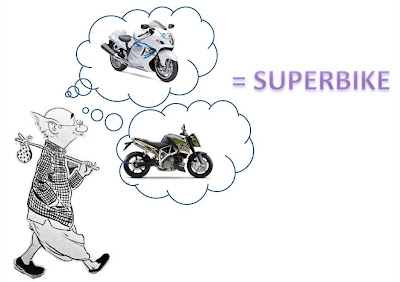
Show an average Indian a photo of the Suzuki Hayabusa and ask him, what kind of bike is it? The answer in most cases would be, SUPERBIKE..!!


Superbikes for a Common Indian
[The Common Man sketch: RK Laxman]

Proceed to show him the photo of a KTM 990 Super Duke, a 1000cc Yamaha FZ1 or even the Ninja 250R. The answer would still be SUPERBIKE. For most Indians the term Superbike is actually a generic name for a imported motorcycle with a big (in the Indian context) engine with a FAT rear tyre..!!

For someone who has been fed on a regular diet of 100 cc motorcycles, it is hardly surprising. To tell the truth, till not very long ago, even I used to loosely use the term "Superbike" to describe the exotic crotch rockets.


So what is a Superbike?


A quick browse through the websites of the 4 mighty Japs (Honda, Kawasaki, Suzuki and Yamaha) reveals that each manufacturer currently has at least two full faired, top of the line sports motorcycles (crotch rockets) from its lineup, a 1000 cc and another 600 cc.


Honda: CBR 1000RR and CBR600RR

Kawasaki: Ninja ZX-10R and Ninja ZX-6R

Suzuki: GSX-R1000 and GSX-R600 (Suzuki also has a GSX-R 750)

Yamaha: YZF-R1 and YZF-R6


To cut the long story short, the above mentioned 1000 cc bikes (also called as the liter class) are sometimes referred as "Superbikes" and the 600 cc models as "Super Sport" bikes.

The four Japanese manufacturers though have listed (in its websites) their 1000 cc and 600 cc models together under the "Super Sports" category and have not created a separate "Superbike" category for their 1000 cc models. At the same time, Ducati does categorize its 848 and 1198 as a "Superbike" on its website.


Why are they called so?

"Superbike" racing is actually a category of motorcycle racing and the "Super Sport" category of racing is a support class to the "World Superbike Championship". The motorcycles used for racing in these championships are basically derived from standard production models with tightly regulated modifications.

According to rules laid down, the "Superbike" racing motorcycles must have four-stroke engines between 750 cc and 1000 cc for four cylinder engines and between 850 cc and 1200 cc for twin cylinder motorcycles. The "Super Sport" racing motorcycles must have four-stroke engine with engines up to 600 cc for four cylinder and 750 cc for twin-cylinder bikes.

Therefore the production models, from which the racing bikes for the "Superbike" Championship and the "Super Sports" Championship are derived, are also sometimes referred to as "Superbikes" and "Super Sports" bikes respectively. These models are developed to perform on race tracks.


2009 WSB Yamaha R1

2009 WSB Yamaha R1


[For more on Superbike racing, click here]

[For more on Supersport racing, click here]

[Visit the World Superbike Championship website, click here..]


What is MotoGP?

MotoGP is the two wheeler equivalent of what Formula 1 racing is for cars. Motorcycles are specifically developed to participate in MotoGP.


125-150 cc motorcycles categorized as Super Sports?

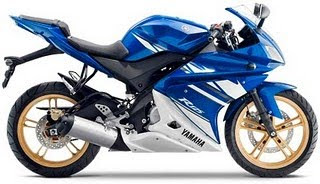
Yamaha and Honda currently have two 125 cc models which they categorize as Super Sports. It’s the Yamaha YZF-R125 and CBR125R respectively.

Yamaha YZF R125Unlike the 1000 cc and 600 cc models, these two particular 125 cc models do not have a racing category to cater to and are basically beginners’ bikes. But due to the styling inspiration from the bigger 600-1000 cc bikes, the manufacturers have decided to brand these two 125 cc bikes under Super Sports category.

Even at the time of launch of the Yamaha R15 in India, it was marketed as India’s first Super Sports bike. Now it’s left to you to decide whether to accept whether the sub 600 cc models qualify as a Super Sports bike. Kawasaki though calls its Ninja 250R just as a Sport Bike and not as a Super Sports bike.


What about the Suzuki Hayabusa then?

Thanks to the Bollywood flick Dhoom and the Bollywood star John Abraham (once owner of the Hayabusa), the average Indian Joe at least recognizes the Hayabusa as a Japanese Superbike. But the 1300 cc Hayabusa is a bit heavy and big to be used as a motorcycle for racing and therefore is not a Superbike or a Super Sports bike. The Hayabusa is basically meant for attaining straight line speeds. For its Hyper performance the Hayabusa is often referred as a "Hyper Sports bike".


What about bikes like the KTM 990 Super Duke and Yamaha FZ1?

These motorcycles are designed more for street use rather than for the race track and can be categorized as "Street Bikes".


So there we have it, not every imported motorcycle with a big engine and a Fat rear tyre is a SUPERBIKE.


Related Posts


Disclaimer:

This is to remind that the Views or Opinions in the blog are entirely mine unless explicitly stated. The Views and Opinions published in this blog should in no way be related to any other person or organization associated -- directly or indirectly -- with me.


Feb 23, 2010

8 2010 TVS Star City details, TVS Star Sport becomes TVS Sport, TVS Star stopped (?)

100 cc action from TVS Motor: TVS gives its "Star City" a makeover for 2010.. also the TVS Star Sport has been re-branded/re-named as TVS "Sport".. TVS "Star" production probably stopped

Two major changes in the 2010 TVS Star City and TVS Sport:1. Adoption of 17 inch wheels diameter instead of the earlier 18 inch ones

2. The rear grab rail is now fabricated out of sturdy fiber material instead of alloy or metal

Details for the two 2010 models had been updated on the official TVS website just a couple of days back. With no media launch for the 2010 TVS Star City and the 2010 TVS Sport, it can be termed as a "soft launch". The changes on the models are very subtle too.

I. 2010 TVS Star City:

The main changes in the 2010 Star City over the earlier model is basically limited to styling. The galloping horse decal on the tank has been changed to a new design. The engine gets the now very common black treatment along with the rear grab rail. The alloy wheels though still remain in silver finish. From the tech specs, it seems that the 110 cc engine remains the same as the older variant.

2010 TVS Star City

2010 TVS Star City

2007-09 TVS Star City

2007-09 TVS Star City


TVS Star Sport Mobile Charger

India's first mobile charger on a motorcycle:

The 2010 Star City does get a mobile charger. Even though this feature is available on many scooters, it is a first for a motorcycle in India.

I don't know how useful it might be on a commuter bike, but on slightly bigger bikes which are used for touring, such a feature might be useful for GPS enabled mobile phones.


Even if I have never ridden the TVS Star City, I have not heard anything bad about the TVS Star City either. The TVS Star City was also the fist 100 bike in India (back in 2007) to feature an Electric Start. But somehow the Star City never managed to sell in big numbers as the other 100 cc bikes from Hero Honda or Bajaj.

Will this 2010 makeover manage to find more fans?


II. 2010 TVS Sport

The biggest change in this 100 cc bike is that it has been re-branded/re-named as TVS Sport. Originally launched as TVS "Star" Sport in 2007, mechanically this bike also seems to be same as the older variant.

The 2010 Sport also gets a fresh set of decals and black paint to the engine and grab rails.

What's in a name, you might ask? I don't know exacly.. but I could not see the "Star" connection in the older variant. Maybe its better this way.

2010 TVS Sport

2010 TVS Sport

2007-09 TVS Star Sport

2007-09 TVS Star Sport


[Details about Pricing could not be found on the TVS Website]


III. TVS Star production stopped:

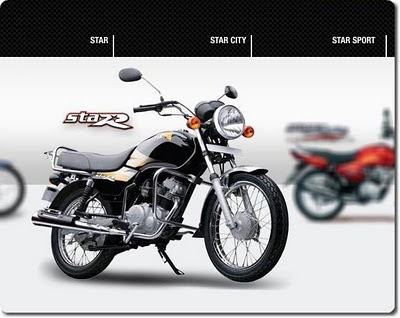
2007 TVS Star

Details of the TVS Star, the 100 cc entry level bike, has been removed from the TVS site.

The production probably has been stopped for this particular model.


Related Posts


Disclaimer:

This is to remind that the Views or Opinions in the blog are entirely mine unless explicitly stated. The Views and Opinions published in this blog should in no way be related to any other person or organization associated -- directly or indirectly -- with me.


Feb 21, 2010

16 Pulsar 135LS Review [Part II] What's so special about the Pulsar 135LS?

What’s so special about the Pulsar 135LS..??

The "LS" in the name stands for "Light Sports", and that exactly is what makes this baby Pulsar special.

Light: Being Light in weight provides a good power to weight ratio:

The bike weights just 122 Kgs with fuel and engine oil. A massive 21 kgs lesser the Pulsar 150 and other 150 cc bikes as well. It means that the 13.5 Ps generated by the engine is not wasted in hauling more of the dead weight of the bike. This gives the Pulsar 135LS a power to weight ratio that is even better than the Pulsar 150, Unicorn, CBZ Xtreme, Hunk, FZ-16, Fazer (any of the current air-cooled 150 cc bikes)..!!pulsar 135LS


Sports: 4 Valve per cylinder engine with DTS-i (Digital Twin Sparkplug Ignition) engine provides Sports bike like performance.

What’s a 4 Valve per cylinder engine and what is its benefit?

After tasting first blood with the Pulsar 135LS, I just can't wait to ride bigger Pulsars with a 4 Valve head..!!

The Pulsar 135LS is the first bike from an Indian bike manufacturer to feature a 4 valves per cylinder layout. In a 4 valve single cylinder engine, there are 2 valves to let in the "air + fuel" mixture and another 2 to let out the exhaust gases. A very simple analogy would be: Imagine if you have 4 nostrils to breathe instead of 2. This would mean that we would be able to suck in more amount of air and expel more air and that too faster whenever we would need it most, that is while running hard.

4 Valve DTS-i Engine


Almost all the bikes manufacturer in India has the 2 Valve per cylinder layout. In a 2 valve engine, the "air + fuel" mixture is fed into the cylinder via one intake valve and the second valve lets out the exhaust gases after the combustion. Most normal riding, these basic 2 valves per cylinder layout is more than enough as in day to day riding one will rarely rev the bike to its limit like on a sports bike. International super sports bikes like the Yamaha R1, Honda CBR 1000RR, Suzuki GSX-R1000 etc. all feature the 4 valves per cylinder layout.

In a 4 valve single cylinder engine, the engine can suck in more "air + fuel" mixture and also expel the exhaust gases at a faster rate. It means that the engine will perform better at higher revs and allow you to rev it higher. The DTS-i engine further ensures that the fuel is burnt optimally and efficiently.


Are there any drawbacks of a 4 Valves per cylinder engine?

The now extinct Kinetic – Hyosung GF125/170 were bikes that first came with the 4 valve per cylinder layout

Currently the Yamaha R15 and the Ninja 250R are the bikes with the same layout

The high end performance definitely improves in a 4 valve engine, but as a trade-off the low end grunt of the engine tends comes down a little bit. This is the reason why the Yamaha R15 and the Pulsar 135LS seem to have less pickup at slow speeds.

To overcome this, the engine can be designed where the stroke is shorter than the bore of the engine cylinder. This is done so that the engine can be revved faster. The other solution could be and which the Bajaj R&D has resorted to in the pulsar 135LS, is to make the Stroke longer than the Bore of the engine. This improves the torque at low engine revs to potter around town and therefore be rewarded by good fuel efficiency. And when in a sporty mood, one needs to rev the engine hard and benefit from the 4 valves per cylinder layout.


But why am I so excited with the Pulsar 135LS..?? Haven't I ridden better and faster bikes than it..??

I have in fact ridden faster and more exciting bikes than the Pulsar 135LS. But the reason for my excitement is that, if the Pulsar 135LS is the shape of things to come from the Pulsar stables (read: faster, lighter, sharper handling).. I just can't wait for the future.

After tasting first blood (of the 4 Valve engine) with the Pulsar 135LS, I just can't wait to ride the bigger Pulsars with a 4 Valve head..!!


Pulsar 135 LS: Price

Rs. 51,000 (Ex-showroom Delhi)


Colors:
  • Passion Red

  • Midnight Black


Bajaj Pulsar 135 LS Specifications:

    Engine Type: 4 stroke, air cooled, 4-valve, single cylinder, SOHC, DTS-i
    Displacement: 13.66cc
    Max Power: 13.5Ps @ 9000rpm
    Max Torque: 11.4Nm @ 7500rpm
    Bore x Stroke: 54 x 58.8
    Compression Ratio: 9.8:1

    Gear Box: 5 Speed (Pattern- 1 Down, 4 Up)
    Starting: Kick + self start

    Front Suspension: Telescopic front fork with antifriction bush (Stroke 130)
    Rear Suspension: Trailing arm with Co Axial Hydraulic cum gas filled adjustable shock absorbers and triple rate coil spring

    Front tyre: Tubetype Unidirectional 2.75 x 17″
    Rear tyre: Tubetype Unidirectional 100/90 x 17″

    Front Brakes: 240 mm Disc Brakes
    Rear Brakes: 130 mm Drum Brakes

    Fuel Tank: 8 liters, 2.5 liter reserve (1.6 liter usable)
    Headlamp: 35/35w
    Electricals: Full DC

    Wheelbase: 1325mm
    Ground clearance: 170mm
    Kerb Weight: 122 kgs


Related Posts


Disclaimer:

This is to remind that the Views or Opinions in the blog are entirely mine unless explicitly stated. The Views and Opinions published in this blog should in no way be related to any other person or organization associated -- directly or indirectly -- with me.